Story by Pfc. Andre Gremillion Jr
100th Mobile Public Affairs Detachment
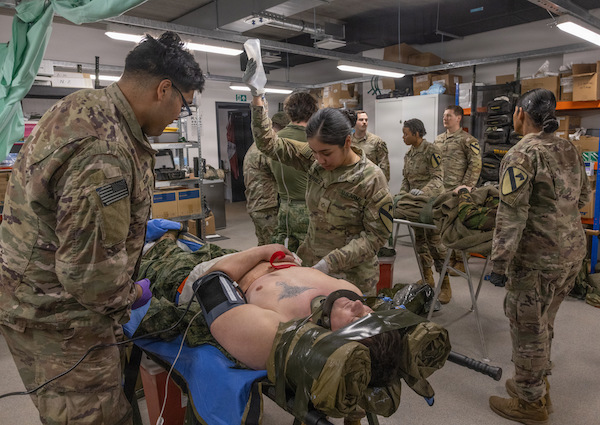
PABRADĖ TRAINING AREA, Lithuania – U.S. Soldiers assigned to 1st Battalion, 12th Cavalry Regiment, conducted medical training on simulated casualties alongside Dutch and Czech medics during Operation Medic Shield, on Pabradė Training Area, Lithuania, March 17, 2026. The medical training exercise provided the U.S., Dutch, and Czech military medical personnel the opportunity to exchange knowledge and procedures.
The training focused on treating and transporting simulated casualties from point of injury to the 1-12 Cav medical aid station. Medics assessed injuries and stabilized patients in the field before transferring them by ambulance to a higher level of care.
“The ambulance used was Dutch,” said U.S. Army Sgt. Patrick Kuykendall,1-12 Cav medical evacuation squad leader. “U.S. Soldiers helped unload the ambulance and received a handoff.”
Once simulated casualties arrived inside the battalion aid station, they were assigned a bed and combat medics reviewed field treatment and continued care under the supervision of leadership. This multinational training allowed NATO allies to compare procedures and become familiar with additional techniques while working through casualty scenarios.
“One of the big takeaways was seeing how differently we operate, but also how similarly,” said Sgt. 1st Class Tyler Ogden, 1-12 Cav medical platoon sergeant. “They have different ways of doing a lot of the same things that we do.”
“We got to do a lot of bed training, something evac typically doesn’t get to train on.” Said Kuykendall. “It kinda got them out of their comfort zone a little bit, and for some of the junior Soldiers, they got to have that experience of grading with foreign allies, which was cool.”
The U.S. medics demonstrated to the allied nations how to perform blood transfusions. By practicing these skills, both U.S. and NATO partners improved their ability to treat patients in the field and at aid stations. This medical training exercise strengthened coordination among allied forces and ensured they could work together to provide effective medical care during operations.
“Showing them something that we can do [blood transfusions] that serves as a battlefield multiplier was valuable for our NATO partners, especially in future conflicts,” Ogden said.

1st Battalion, 12th Cavalry Regiment, conducts a medical training exercise alongside NATO Partners added by militarymedical on
View all posts by militarymedical →